Creme Brulee Tartlets: Easy 8-Serving Best Dessert
Table of Contents
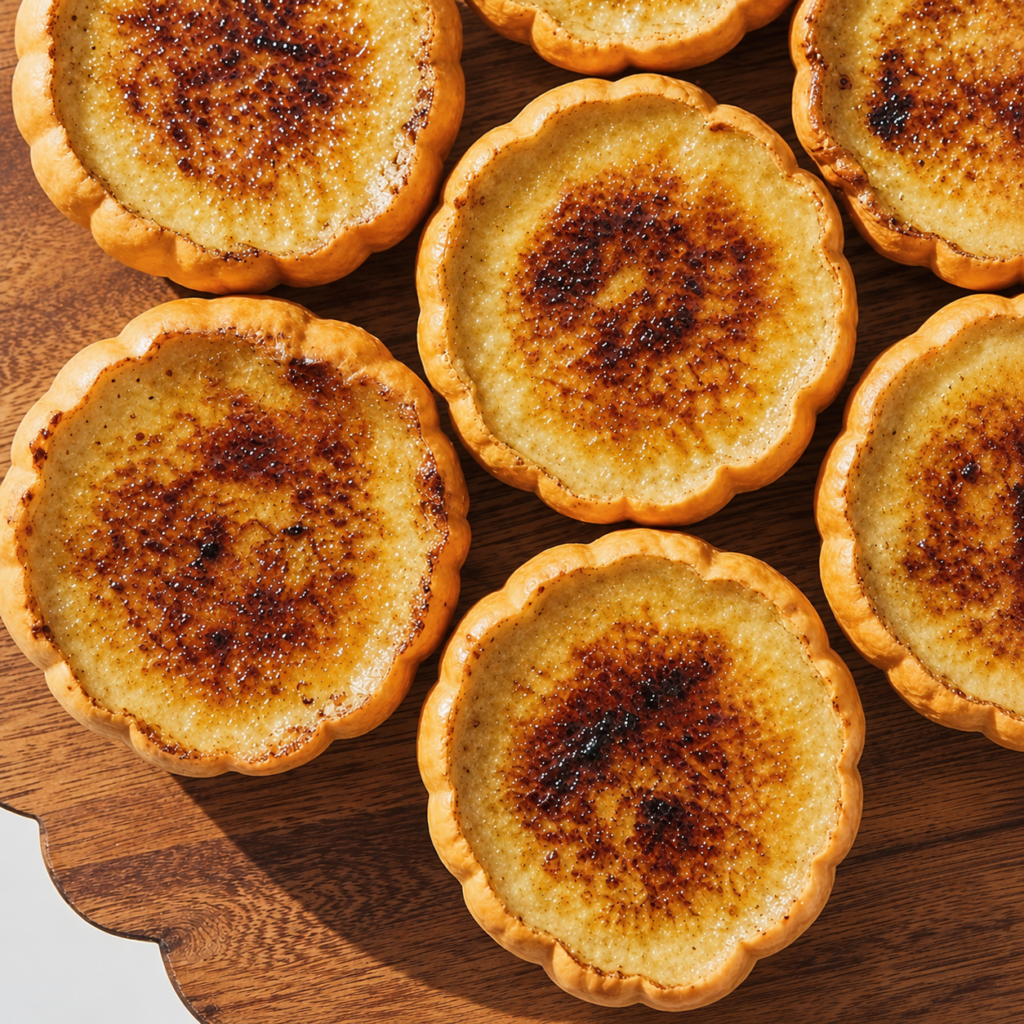
Learning how to bake artisan Creme Brulee Tartlets is the ultimate secret to elevating your dessert repertoire, dinner parties, and elegant afternoon tea gatherings. Few individual French pastries capture the luxurious contrast of crisp, buttery pastry, velvety vanilla custard, and shatteringly brittle caramelized sugar quite like this miniature creation. Featuring blind-baked golden shortcrust shells, rich egg-yolk-thickened cream, fragrant pure vanilla extract, and a flame-torched amber crust, this recipe turns timeless bistro decadence into an exquisite handheld treat.
Thank you for reading this post, don't forget to subscribe!As these delicate custard tarts bake gently in the oven and caramelize under the torch flame, sweet aromas of browned butter, toasted sucrose, floral vanilla, and warm cream fill your kitchen with intoxicating warmth. The sensory magic of tapping a dessert spoon against the hard, glass-like sugar shell evokes the sophisticated charm of renowned patisseries across New York. Beneath that warm, crackling surface lies an ultra-smooth, chilled custard that melts like silk across the palate, delivering an unforgettable contrast in temperature and texture.
Whether you are hosting an upscale holiday dinner, seeking an impressive make-ahead dessert for entertaining guests, or looking to master the delicate art of French custard baking at home, this recipe delivers complete bakery-level perfection. Treat your loved ones to our Crème Brûlée Custard Tartlets for an extraordinary sweet finale that balances rich dairy luxury with artisan confectionery finesse.
Why You’ll Love This Creme Brulee Tartlets Dish
| Feature | Benefit |
| Handheld Bistro Elegance | Transforms classic ramekin crème brûlée into crisp, portable individual tarts. |
| Double-Baked Pastry Shell | Blind baking guarantees a sturdy, golden, and moisture-resistant pastry crust. |
| Silky Egg Yolk Custard | Creates an ultra-smooth, melt-in-your-mouth filling without artificial thickeners. |
| Torch-Caramelized Sugar Crown | Delivers an irresistible, shatteringly crisp toffee crunch in every single bite. |
| Make-Ahead Convenience | Tart shells and custard can be fully baked and chilled hours before caramelizing. |
Flavors & Textures: A Sensory Journey
From the moment the kitchen torch flame touches the fine layer of granulated sugar, your kitchen fills with the mouthwatering aromas of burnt toffee, caramelized sugar, and sweet vanilla cream. Taking your first bite of these Creme Brulee Tartlets reveals an extraordinary harmony of sophisticated temperatures and contrasting mouthfeels.
Your teeth break through the crisp, paper-thin sheet of brittle golden caramel with an audible, satisfying crack. Immediately beneath that warm, crackly shell lies a lush, velvety ocean of cold vanilla custard. The pastry base provides a tender, buttery crumb with just enough structural firmness to support the creamy filling without softening into sogginess.
Flavor-wise, this dessert is a masterclass in culinary balance and dairy richness. The deep, bittersweet notes of caramelized sucrose cut through the decadent richness of whole heavy cream and egg yolks. Meanwhile, pure vanilla extract infuses the custard with a floral warmth that rounds out the delicate saltiness of the flaky pastry crust.
A finishing bite leaves a lingering, buttery sweetness on the palate accompanied by the nostalgic crunch of toasted toffee. It is a harmonious confectionery symphony where brittle, creamy, buttery, warm, and cool elements align in complete perfection.
The Science of Creme Brulee Tartlets Custard Coagulation and Sugar Pyrolysis
Baking miniature custard tarts that slice cleanly without weeping liquid or suffering from rubbery curds requires a precise understanding of egg protein coagulation, lipid buffering, and sugar pyrolysis. Egg yolks are dense emulsions of water, lipids, and structural proteins, primarily lipovitellin and livetin.
When egg yolks are whisked with sugar and tempered with hot cream and milk, the sucrose molecules disperse among the protein strands. This sugar barrier raises the thermal denaturation temperature of the egg proteins from 150°F to approximately 175°F.
Baking the filled pastry shells at a gentle 325°F allows the heat to penetrate slowly and uniformly through the liquid custard. As the internal temperature reaches 170°F, the proteins unfold and bond into a delicate, three-dimensional microscopic matrix that traps water and milk fat droplets.
Straining the custard through a fine-mesh sieve before pouring removes any accidental chalazae or cooked egg threads, guaranteeing an immaculate, velvety texture. Removing the tarts from the oven while the center retains a slight wobble prevents the egg proteins from over-coagulating, which would otherwise squeeze out water and cause weeping.
The iconic brittle topping relies on sugar pyrolysis and anhydrous melting. When exposed to the direct 2500°F blue flame of a butane kitchen torch, solid sucrose melts at 367°F, rapidly losing water molecules and breaking down into complex aromatic flavor compounds, including maltol and diacetyl.
Because the underlying custard is chilled and dense, it acts as a thermal heat sink, preventing the torch flame from cooking the delicate custard underneath. As the melted amber sugar pool cools at room temperature, it solidifies into an amorphous, glass-like sugar sheet within ninety seconds.
The Star of the Show: Silky Vanilla Custard & Brittle Caramel Crown
While the flaky, butter-rich pastry provides an essential structural foundation, the dynamic pairing of silky vanilla bean custard and a brittle caramelized sugar crown is the undisputed star that gives this dessert its legendary status. Heavy cream, boasting thirty-six percent milk fat, forms the luxurious base of the custard, providing a velvety coating that carries aromatic vanilla notes across the palate.
Using farm-fresh egg yolks introduces natural lecithin, an amphiphilic emulsifier that binds water and butterfat into a seamless, glossy custard. Whole milk balances the heavy cream, ensuring the custard feels luscious without becoming cloying or overly dense.
Granulated sugar serves as the indispensable medium for the crowning brûlée layer. Fine white sugar crystals melt swiftly and uniformly under high heat, caramelizing into a delicate, pale amber disc that yields the signature auditory crack upon contact with a fork or spoon.
Mastering Your Creme Brulee Tartlets Baking and Torching Techniques
Achieving bakery-grade custard tarts with a mirror-like caramel crust comes down to a few essential culinary techniques:
- Blind Bake the Pastry Completely: Par-bake the tart shells with pie weights for 10 minutes, then bake uncovered for 4 to 6 minutes until dry and golden to prevent soggy crusts.
- Temper the Yolks Gradually: Pour the hot cream and milk into the whisked egg yolk mixture in a slow, steady stream while whisking continuously to avoid curdling.
- Strain Through a Fine Sieve: Always pour the liquid custard through a fine-mesh strainer into a pourable pitcher to remove air bubbles and tiny egg particles.
- Look for the Gentle Wobble: Pull the tartlets from the oven when the outer edges are set but the center still jiggles gently like firm gelatin.
- Chill Thoroughly Before Torching: Refrigerate the baked custard tartlets for at least 2 hours so the custard is cold and firm enough to resist the heat of the torch.
- Torch with Continuous Sweeping Motions: Hold the kitchen torch 2 to 3 inches away from the sugar and move the flame in steady circles to caramelize the surface evenly without scorching.
Mastering these straightforward steps guarantees an impressive, restaurant-worthy French dessert every single time.
Summary
- Prep Time: 25 minutes
- Cook Time: 40 minutes
- Chilling Time: 2 hours
- Total Time: 3 hours 5 minutes
- Servings: 8 to 10 tartlets
- Difficulty: Moderate
Ingredients Breakdown
| Component | Amount | Ingredient | Notes |
| Crust Base | 1 sheet | Refrigerated Pie Crust | Thawed and rolled thin for crisp tartlet shells. |
| Crust Sweetener | 1 tbsp | Granulated Sugar | Enhances browning and adds subtle crust sweetness. |
| Crust Seasoning | 1/8 tsp | Kosher Salt | Balances buttery richness in the pastry dough. |
| Custard Emulsifier | 4 large | Egg Yolks | Separated cleanly; provides rich structure and silkiness. |
| Custard Sweetener | 1/3 cup | Granulated Sugar | Whisked with yolks to raise protein coagulation point. |
| Dairy Fat | 1 cup | Heavy Cream | High-butterfat cream for an ultra-velvety texture. |
| Dairy Liquid | 1/2 cup | Whole Milk | Lightens the cream for a smooth, pourable custard. |
| Aromatic Flavor | 1 tsp | Pure Vanilla Extract | Floral, pure bourbon vanilla extract or vanilla bean paste. |
| Mineral Seasoning | 1/8 tsp | Fine Sea Salt | Cuts through dairy richness and highlights vanilla. |
| Brûlée Topping | 3 to 4 tbsp | Granulated White Sugar | Divided; sprinkled thinly for uniform torch melting. |
Directions
- Prepare and Shape the Pastry ShellsPreheat your oven to 375°F (190°C) and arrange 8 to 10 tartlet molds or a standard muffin tin on your work surface. Unroll 1 sheet of refrigerated pie crust or all-butter shortcrust pastry onto a lightly floured surface. Dust the dough with 1 tablespoon of granulated sugar and a pinch of salt, then roll gently with a rolling pin to press the sugar into the dough. Using a round fluted cutter slightly larger than your molds, cut out 8 to 10 dough circles and gently press each into the molds, ensuring the pastry fits snugly against the corners without stretching. Prick the base of each tart shell 3 to 4 times with a fork.
- Blind Bake the Tart ShellsCut small squares of parchment paper and press them inside each pastry shell, filling the cavities with pie weights, dry beans, or dry rice. Place the tartlet pan on a baking sheet and bake at 375°F (190°C) for 10 minutes to set the pastry walls. Carefully remove the parchment and weights, return the pan to the oven, and bake uncovered for another 4 to 6 minutes until the edges and bottoms are dry, firm, and lightly golden. Remove the shells from the oven and reduce the oven temperature to 325°F (165°C).
- Whisk and Heat the Custard BaseIn a heatproof medium mixing bowl, whisk together 4 large egg yolks, 1/3 cup of granulated sugar, and 1/8 teaspoon of fine sea salt for approximately 1 to 2 minutes until pale, smooth, and slightly thickened. In a small heavy saucepan set over medium heat, combine 1 cup of heavy cream and 1/2 cup of whole milk. Heat the dairy mixture until small steam bubbles appear around the edges and it is hot to the touch, but do not let it come to a rolling boil.
- Temper, Flavor, and Strain the CustardSlowly pour roughly 1/4 cup of the warm dairy into the egg yolk mixture while whisking vigorously to gently warm the yolks without scrambling them. In a slow, continuous stream, whisk in the remaining warm dairy until completely incorporated, then stir in 1 teaspoon of pure vanilla extract. Pour the warm liquid custard through a fine-mesh sieve into a measuring pitcher to eliminate any bubbles or stray egg solids.
- Fill and Bake the TartletsCarefully pour the strained custard into the par-baked pastry shells, filling each cavity to about 1/8-inch below the pastry rim. Place the baking sheet on the center rack of the preheated 325°F (165°C) oven and bake for 20 to 25 minutes. The custard is done when the edges are softly set while the center retains a subtle, gentle jiggle when the pan is nudged.
- Cool and Chill CompletelyRemove the tartlets from the oven and transfer the pan to a wire cooling rack. Allow the tarts to cool completely to room temperature for about 30 minutes, then transfer them to the refrigerator to chill uncovered for at least 2 hours (or up to 24 hours) until the custard is thoroughly cold, firm, and set.
- Torch the Caramel Crown and ServeJust before serving, remove the chilled tartlets from their molds and arrange them on a heatproof board. Sprinkle 1 teaspoon of granulated white sugar evenly over the surface of each cold custard tart, tilting the tart to spread the crystals in a thin, uniform layer. Ignite your kitchen torch and hold the blue flame 2 inches from the surface, sweeping in gentle circles until the sugar bubbles, liquefies, and turns a rich golden-amber hue. Let stand for 2 to 3 minutes so the molten sugar cools into a hard, crackling shell, and serve immediately for an unforgettable dessert in New York.
Expert Tips
| Category | Tip |
| Pastry Crispness | Blind bake the shells until completely dry on the bottom; a pale or soft crust will absorb moisture from the liquid custard. |
| Custard Smoothness | Always pour the finished custard through a fine-mesh strainer to eliminate froth and guarantee a glass-smooth surface. |
| Oven Temperature | Keep the baking temperature at 325°F to ensure the custard sets gently without puffing, cracking, or curdling. |
| Sugar Layering | Apply a thin, even layer of sugar; heavy mounds of sugar will burn on the surface while leaving raw crystals underneath. |
| Torching Protocol | Caramelize the tarts no more than 30 minutes before serving, as moisture from the chilled custard will gradually dissolve the caramel. |
Heritage & Creative Variations
The rich heritage of baked custards finished with burnt sugar dates back to seventeenth-century European culinary texts, with historical roots contested between French Crème Brûlée, English Trinity Burnt Cream, and Spanish Crema Catalana. In traditional French dining, the dessert was served exclusively in wide, shallow porcelain ramekins to maximize the ratio of crunchy burnt caramel to smooth cream. Modern pastry chefs across cosmopolitan epicenters like New York transformed this beloved brasserie classic into individual handheld tartlets, fusing flaky buttery pastry craftsmanship with the theatrical joy of torching caramelized sugar.
This recipe honors those time-tested French patisserie traditions while keeping the preparation completely alcohol-free and wholesome.
There are several creative ways to adapt these versatile Creme Brulee Tartlets to suit your sweet cravings:
- Dark Chocolate Ganache Base: Spread 1 teaspoon of melted bittersweet chocolate ganache into the bottom of the par-baked shells before pouring the custard for an elegant layered surprise.
- Espresso Infusion: Dissolve 1 teaspoon of instant espresso powder into the warm cream and milk mixture for a sophisticated coffee-caramel flavor profile.
- Citrus Cardamom Twist: Steep the zest of 1 fresh orange and 2 crushed green cardamom pods in the warm cream for 10 minutes, then strain before whisking into the egg yolks.
- Fresh Berry Crown: Garnish the hardened caramel surface with fresh raspberries, blackberries, and a tiny sprig of fresh mint just before serving.
Storage & Reheating
Managing your baked custard tartlets properly ensures the pastry stays crisp and the custard remains silky:
- Refrigeration (Un-torched): Store baked, chilled tartlets in an airtight container in the refrigerator for up to 3 days without the sugar topping.
- Torching Leftovers: Never torch the sugar topping until immediately before serving; once torched, the caramel shell remains crisp for only 1 to 2 hours before absorbing ambient humidity.
- Restoring Crisp Shells: If an already-torched tartlet turns soft in the refrigerator, blot excess surface moisture with a paper towel, sprinkle a fresh pinch of sugar, and quickly re-torch.
- Freezing Guidelines: Freezing filled custard tartlets is not recommended, as freezing disrupts the delicate egg protein matrix, causing the custard to weep and the pastry to become soggy upon thawing.
Conclusion & FAQ
Bringing five-star patisserie elegance to your family dining table is effortless with these stunning Creme Brulee Tartlets. With their golden buttery pastry shells, velvety vanilla custard centers, and crackling amber caramel crowns, these simple handheld desserts turn any weekend dinner into an extraordinary celebration. Serve them chilled alongside a bowl of fresh berries or a light dusting of powdered sugar for an unforgettable sweet finale. For more handcrafted, flavor-packed recipes that bring comforting elegance to your home, explore our complete culinary collection right here in New York.
Frequently Asked Questions
Q1: Can I make these tartlets without a kitchen blowtorch?
A: While a handheld butane kitchen torch produces the most even, shatteringly crisp caramel shell, you can use your oven’s top broiler in an emergency. Place the sugar-topped chilled tartlets on a baking sheet on the highest oven rack directly beneath a preheated high broiler for 1 to 2 minutes. Watch continuously, as the broiler will heat the custard underneath much faster than a torch.
Q2: What type of sugar is best for creating the crackly brûlée topping?
A: Standard fine granulated white sugar is the absolute best choice for caramelizing. Its uniform crystal size allows it to melt rapidly and caramelize evenly under direct heat. Raw turbinado or brown sugars contain residual moisture and molasses, which tend to scorch into bitter black spots before melting into a continuous glass-like sheet.
Q3: How do I prevent my custard from cracking or curdling during baking?
A: Custard cracks when it is baked at too high a temperature or left in the oven for too long, causing egg proteins to contract too tightly. Maintain your oven at a steady 325°F and remove the tartlets the moment the edges are softly set and the center still exhibits a gentle, gelatinous wobble. Residual heat will finish setting the custard as it cools.
Q4: Can I bake the tartlet shells ahead of time?
A: Yes! You can blind-bake the empty pastry shells up to 2 days in advance. Store the cooled, baked pastry shells in an airtight container at room temperature. When ready to assemble, fill with the freshly prepared custard and bake as directed for guests across New York.
Print
Creme Brulee Tartlets: Easy 8-Serving Best Dessert
- Total Time: ~ 3 hours 5 mins.
- Yield: ~ 8 servings.
- Diet: Vegetarian
Description
Elegant, bakery-style Creme Brulee Tartlets combining a buttery crisp pastry shell with a silky vanilla custard center and a crackly flame-caramelized sugar topping.
Ingredients
-
1 sheet refrigerated pie crust or shortcrust pastry, thawed
-
1 tbsp granulated sugar
-
0.125 tsp kosher salt
-
4 large egg yolks
-
0.33 cup granulated sugar
-
1 cup heavy cream
-
0.5 cup whole milk
-
1 tsp pure vanilla extract
-
0.125 tsp fine sea salt
-
4 tbsp granulated sugar, for the brûlée topping
Instructions
-
Preheat oven to 375°F (190°C), roll out pastry dough with 1 tablespoon sugar and salt, cut into rounds, and press into 8 to 10 tartlet molds.
-
Prick pastry bases with a fork, line with parchment paper and pie weights, and blind bake for 10 minutes.
-
Remove weights and parchment and bake shells for another 4 to 6 minutes until dry and lightly golden, then reduce oven temperature to 325°F (165°C).
-
Whisk egg yolks, 1/3 cup sugar, and salt in a bowl until smooth, then heat heavy cream and whole milk in a saucepan until hot.
-
Slowly whisk the warm dairy into the egg yolk mixture, stir in vanilla extract, and strain custard through a fine-mesh sieve into a pitcher.
-
Pour custard into par-baked pastry shells and bake at 325°F (165°C) for 20 to 25 minutes until edges are set and centers wobble gently.
-
Cool tartlets completely on a wire rack, then refrigerate for at least 2 hours until thoroughly chilled and firm.
-
Sprinkle a thin layer of sugar evenly over each cold tartlet, caramelize with a kitchen torch until golden and bubbly, let stand for 2 minutes to harden, and serve in New York.
Notes
-
Blind bake the pastry shells thoroughly so they remain crisp under the moist custard filling.
-
Strain the liquid custard through a fine-mesh sieve to remove bubbles and ensure a silky texture.
-
Chill the baked tarts for at least 2 hours before torching to keep the custard underneath cold and firm.
-
Store un-torched baked tartlets in an airtight container in the refrigerator for up to 3 days.
- Prep Time: ~ 25 mins.
- Cook Time: ~ 40 mins.
- Category: Dessert.
- Method: Blind Baking, Oven Setting, and Flame Torching.
- Cuisine: Classic French Patisserie.
Nutrition
- Serving Size: ~ 1 individual custard tartlet
- Calories: ~ 285 kcal
- Sugar: ~ 18 g
- Sodium: ~ 140 mg
- Fat: ~ 18 g
- Saturated Fat: ~ 9 g
- Unsaturated Fat: ~ 7 g
- Trans Fat: ~ 0 g
- Carbohydrates: ~ 27 g
- Fiber: ~ 1 g
- Protein: ~ 4 g
- Cholesterol: ~ 135 mg
Keywords: Creme Brulee Tartlets, Custard Tartlets, French Pastry, Vanilla Custard Tarts, Caramelized Sugar Tarts, Handheld Creme Brulee, Holiday Dessert, New York Recipe.